Community Update: 8/11/26
Purdon Rd Tower Appeal Denied
On Tuesday, Aug. 11th, the Nevada County Board of Supervisors voted to deny the appeal presented by the Purdon Road Appellants against the 150-foot cell tower. Powerful community testimony, photos and a compelling appeal were given.
News Article by The Mountain Messenger: https://www.themountainmessenger.org/article/nevada-county-cell-tower
Watch Hearing starting at the 4 hour 36 minute mark: https://www.youtube.com/watch?v=pA8NB_dG0_M
PROJECT DETAILS
Location: 22044 Purdon Road, Nevada City, CA 95959 (APN: 049-060-012)
Conditional Use Permit PLN25-0133; CUP25-0009
Resolution and Appeal Documents: https://nevco.legistar.com/LegislationDetail.aspx?ID=8069605&GUID=8E91137E-B120-4112-9A54-DC4FB717540C
—————————————————————————————————————————————
Community Update: 4/15/26
Board Passes Telecom Ordinance, Silent on Small Cell Concerns
Despite overwhelming public comment, the Board of Supervisors voted to approve the new Communication Towers and Facilities Ordinance with only minor amendments, and pointedly avoided any mention of the issue residents cared about most.
On April 14, 2026, the Nevada County Board of Supervisors approved Section 12.03.080, the updated Communication Towers and Facilities Ordinance, with two amendments: grandfathering existing tower applications under the old permitting process, and modestly strengthening fire safety language.
What was striking, and worth putting on the record, was what the Board chose not to say.
Nearly every public comment submitted at this hearing raised concerns about small cell wireless facilities which is the equipment installed on utility poles in front of your home, without your knowledge, under this ordinance. Speaker after speaker asked the Board to require a Conditional Use Permit for new small cell installations, to give residents notice, and to restore the community's voice in the process.
"There is simply no basis to the argument that requiring a CUP for a new small cell violates any federal law or even any state law." — Telecom attorney W. Scott McCollough, addressing the Board via telephone.
The Board's deliberation contained no acknowledgment of those comments and no discussion of small cells whatsoever. This was not an oversight. Elected officials who choose not to engage with the public record on a contested issue are making a deliberate choice, and that choice is now part of the record too.
Watch the hearing starting at the 4:37 hour & review the transcript: Nevada County Board of Supervisors 4/14/26 Meeting
What this means for your neighborhood:
Under the ordinance as passed, new small cell wireless facilities are exempt from discretionary planning review. That means no public notice, no hearing, no community input. The first many residents will know of an installation is when a crew shows up to do the work. The ordinance will take effect in 30 days.
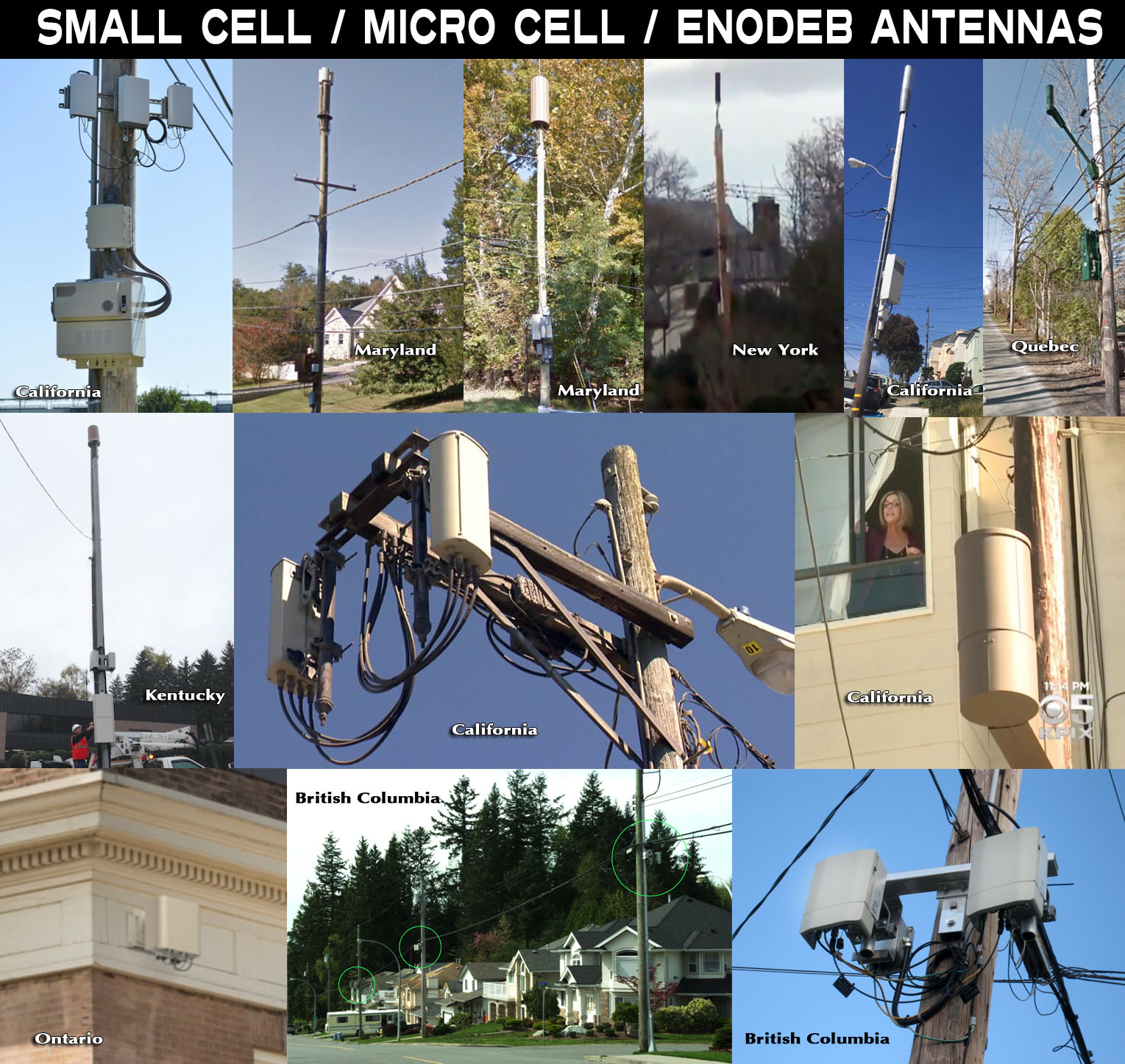
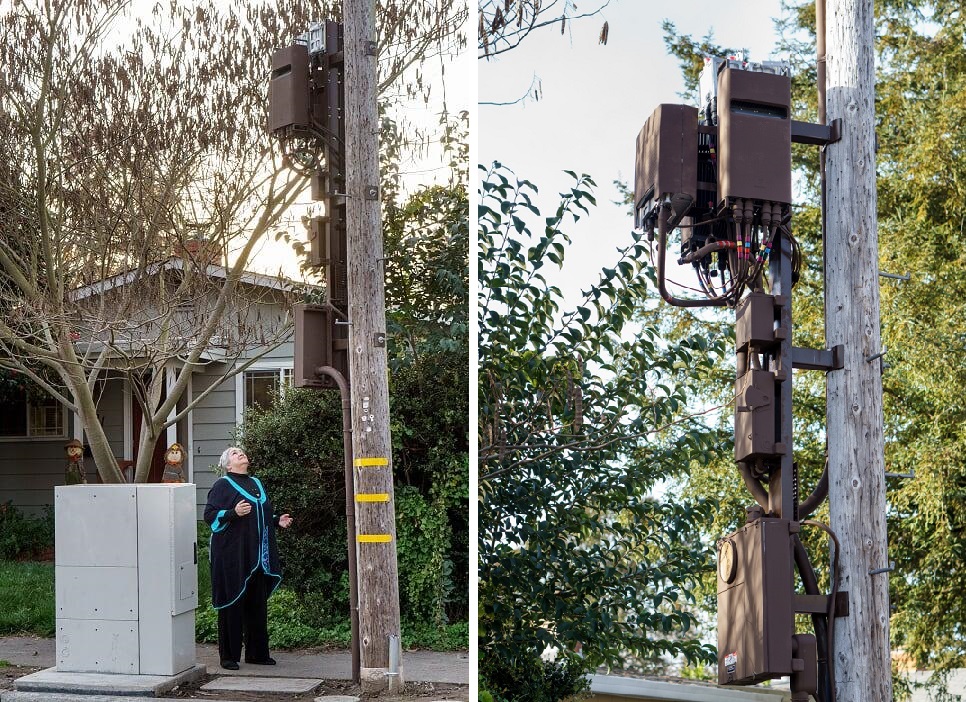
Small cells are not small in impact. A typical deployment includes antennas mounted at the top of a utility pole, plus ground-level and eye-level equipment: cabinets, cabling, and sometimes backup power units and smart utility meters emitting more RF. They are already being deployed rapidly in residential areas across California and in every state. See photos below, keep scrolling…
What You Can Do
If you see new equipment appearing on poles in your area, photograph and document it.
What to watch for in your neighborhood and signs of small cell activity:
New boxes or cylinders on utility poles — antennas are often cylindrical or rectangular, 2–4 feet tall, mounted near the top of existing poles
New metal cabinets at the base of poles — gray or beige utility-style boxes, sometimes padlocked, at ground level or low on the pole
New cabling or conduit running up or along poles, often in gray or black
A building or encroachment permit notice — a building permit notice may be the only public-facing signal before installation begins
Utility trucks with no obvious PG&E markings — crews working on poles for telecom carriers rather than the utility
New small poles being installed — carriers sometimes install new dedicated poles rather than attaching to existing ones
https://www.americansforresponsibletech.org/5g-antenna-identify
Document and photograph any new pole equipment you notice, including location, date, and any permit numbers visible
Share what you find — send photos and locations to info@nevadacountyforsafetech.comso we can track deployment patterns across the county
Contact your Supervisor — let them know you noticed the silence at the hearing, and that you're paying attention
Stay connected — subscribe to updates below so you hear about any new applications or community actions as they develop
To everyone who called their Supervisor, wrote a letter, called in a public comment, drove to a hearing and waited through hours of presentations to speak your 3 minutes THANK YOU
You showed up for this community over and over again, at every stage of a process that was not designed to make it easy. You did it without guarantees, and in many cases without recognition. The record that exists — the legal arguments on file, the testimony in the transcript, the issues the Staff and Board would not address — exists because of you. That record does not disappear because the vote didn't go the way it should have.
This is not over. The ordinance passed, but the community's voice is louder and better organized than it was a year ago. We will keep watching, keep documenting, and keep showing up. Stay Vigilant and Stay Tuned...
— Nevada County for Safe Tech
—————————————————————————————————————————————
4/11/26 - Public Comment Submitted for the 4/14/26 BOS Hearing
Dear Members of the Board,
Before you vote on April 14th, there is something you need to know that is not in the Staff Memo in front of you.
The Planning Commission voted on February 26th to pass this ordinance forward, but every Commissioner simultaneously acknowledged that it contains serious, unresolved gaps. That unanimous acknowledgment does not appear anywhere in the Memo prepared by Planning Director Brian Foss and Staff. You are being asked to adopt an ordinance your own Planning Commission flagged as incomplete, with no information that would allow you to act on that warning.
That omission is not an accident of formatting. It is a failure of the Planning Department's basic obligation to this Board.
At the Commission's direction, Director Foss agreed to meet with community groups before this hearing. Nevada County for Safe Tech (NCST) included telecommunications attorney Scott McCollough, one of the foremost wireless land use lawyers in the country, to a March 31st meeting with Mr. Foss, Attorney Trevor Koski, and Planner David Nicholas. Significant legal vulnerabilities were identified and Staff confirmed they understood them. They have no remaining basis for ignorance. Not one word of that meeting, nor one recommendation from it, appears in the Staff Memo before you. It was buried in Public Comments, with no context (see Document 11 Public Comment for a summary transcript of the meeting and the NCST template).
The Planning Department serves this Board, and through you, the residents of this County. When staff withholds the Commission's own recommendations from the Board's deliberation, that is a failure of accountability this Board should not allow to stand unremarked.
The gaps that were identified, explained to staff, and then ignored are not technical footnotes. They are omissions that could protect this County and instead expose it to industry overreach, legal liability, and harm that cannot be undone after a wireless facility goes up.
1. The ordinance has no variance or waiver mechanism (Subsection K of the NCST template). Without it, the County has no structured legal defense when a carrier challenges a provision as constitutionally prohibitive. Courts have upheld ordinances in federal litigation precisely because a waiver process existed. This ordinance has none.
2. Radio Frequency (RF) testing is set at 60 days post-installation only. No annual certification, random unannounced testing, or good-cause testing triggered by resident qualified complaint. A facility can go live, exceed FCC exposure limits from day one, and the County is ignorant for two months. The County's own Staff Report acknowledges staff lack the expertise to evaluate RF compliance independently. That admission makes the case for robust third-party enforcement more powerfully than any community comment could. If the County cannot evaluate compliance on its own, it must have legal tools to compel carriers to demonstrate it.
3. The ordinance exempts Small Cell Wireless Facilities (SCWF) from discretionary review entirely meaning no Conditional Use Permit, public notice or community input,. A carrier can install one in front of your constituent's home and the first the resident will know about it is when a construction truck shows up.
This is what "less than 28 cubic feet of equipment" looks like in practice.IMAGE 1 OF SMALL CELL FACILITIES IMAGE 2 SANTA ROSA, CA
Staff compares SCWFs equipment volume to less than half a phone booth, as though that framing settles the matter. These are not minor equipment adjustments. They are installed at eye level in front of homes on neighborhood streets, emit massive RF, and under this ordinance, would require only an encroachment and building permit with less scrutiny than a fence permit.
Attorney McCollough, who reviews more small cell right-of-way applications than any other facility type nationwide and has argued FCC matters at the US Supreme Court, told Planning staff directly on March 31st: "There is simply no basis to the argument that requiring a CUP for a new small cell violates any federal law or even any state law." The FCC's own rules and the governing statutes expressly preserve local authority to require discretionary permits for new small cell installations. The County is not required to exempt them. Staff is choosing to do so anyway.
The Staff's proposed 150% of tower height setback for larger macro tower facilities does not address SCWFs at all. The Staff Report claims a siting hierarchy and front yard protections "would prohibit small cell wireless facilities in a large portion of the public right of way,” yet the City of Elk Grove includes precisely this protection in its ordinance and no carrier has challenged it. Staff knows this because the Commissioners asked the Elk Grove resident who helped write that ordinance many questions about it at the February hearing. Staff states opinion as legal fact, without citation, without case law, and in direct contradiction to legal guidance. The FCC's 2018 small cell order does not prohibit preference hierarchies. It requires siting standards be objective, reasonable, and published in advance. The NCST template meets all three. A preference hierarchy is not prohibitive. It places the burden of justification on the applicant. Without it, carriers will site wherever is most convenient.
When County Counsel raised the shot clock as a reason to avoid a CUP process for SCWF, McCollough explained the shot clock is an argument for a more rigorous and complete application process up front, not for eliminating review altogether. A thorough application process protects the County from clock pressure; exempting SCWF from review does not. When County Counsel asked whether carriers had ever successfully challenged a CUP requirement for new small cells as constituting an effective prohibition, McCollough was unequivocal: "When we're talking about new small cells, that is under federal and state law clearly discretionary." Carriers are currently deploying SCWFs across the country at an accelerating pace. Verizon, AT&T, and others are building out capacity networks in rural and semi-rural counties and have asserted that small cells must be spaced every 500 to 750 feet. That claim, McCollough noted, has been factually challenged and is not legally binding. The County is not required to accept it. But under this ordinance, the County has no process through which to examine it.
A Conditional Use Permit for new SCWFs would provide public notice before installation, enable design review, allow assessment of land use compatibility, aesthetics, RF compliance, and siting appropriateness. It would create a documented legal record for any subsequent challenge. It would give residents the basic dignity of knowing what is coming before it arrives.
This ordinance gives all of that away. Planning staff was told clearly why that was wrong and they chose not to act on it.
The residents of Nevada County engaged this process in good faith. They retained expert legal counsel. They submitted a comprehensive template. They attended the workshop, submitted comments, attended the hearing, and participated in the Staff meeting. Their work sits in a public comment file, unacknowledged in the document that governs today's vote.
We ask the Board to adopt the ordinance conditionally, with a formal directive that Planning staff begin substantive revision immediately and set a firm deadline, not an open-ended commitment, for the revised ordinance to return to the Planning Commission, and to include the considerations mentioned above into the County code.
Respectfully submitted,
Nevada County for Safe Tech
—————————————————————————————————————————————
3/3/26
Show Up, Speak Out: Help Shape Nevada County's Wireless Future
Last week, residents filled the chambers at the Nevada County Government Center to weigh in on the draft Communication Towers & Facilities Ordinance Update before the Nevada County Planning Commission.
They did not come empty-handed.
Many speakers referenced detailed corrections and recommended revisions prepared by Nevada County for Safe Tech, a local advocacy group that has spent the last 1.5 years carefully preparing for and reviewing the proposed ordinance. According to the group, their suggested changes were developed with input from attorneys who specialize specifically in telecommunications law, a highly technical and federally regulated field.
Their message was clear: the goal was not to block wireless infrastructure, but to strengthen the ordinance in ways that protect residents while also shielding the County from legal vulnerability.
Telecommunications law sits at the intersection of local land use authority and federal preemption. Counties must navigate complex constraints imposed by federal regulations while still exercising their rights to regulate placement, aesthetics, safety, and process. Mistakes can expose local governments to litigation from either direction, industry challenges on one side, community concerns on the other.
Nevada County for Safe Tech argued that its proposed revisions were designed precisely to avoid that risk. Rather than pushing provisions that would conflict with federal law, the group maintains its edits were crafted within existing legal boundaries, using language already upheld in other jurisdictions. In short, they say their corrections were not radical, they were cautious.
Residents who spoke echoed that sentiment. They described the group’s recommendations as protective rather than prohibitive. Among the requests were stronger and clearer setback language, more precise siting criteria near residential areas, and tighter definitions to prevent unintended loopholes, and reduce fire risks. Several speakers emphasized that clarity in the ordinance ultimately benefits everyone, the County, applicants, regulators, and the public.
The Planning Commission ultimately approved the County staff’s draft as an interim measure so that pending cell tower applications would fall under updated rules. However, commissioners also directed the Planning Department to sit down with community groups including Nevada County for Safe Tech to craft a stronger, more comprehensive ordinance.
As the current measure now moves to the Board of Supervisors for its final consideration later this year, community participation is essential. The more complete and protective this ordinance becomes, the greater the clarity, transparency, and local safeguard it can provide. The draft ordinance does include updates: increased tower setbacks to 150% of tower height, expanded public notice requirements, emergency provisions for temporary facilities and generators, alignment with federal definitions, and clarified permit timelines. These are real improvements.
The Board has an opportunity to examine the submitted corrections in detail and publicly evaluate them on their merits. If certain provisions cannot be adopted due to federal limitations, that explanation should be made clear. If some language can be strengthened without increasing legal risk, that opportunity should not be overlooked.
Public participation is strongest when it includes expertise. In this case, residents did more than voice general concern, they presented drafted legal language informed by specialized counsel. Whether one agrees with every recommendation or not, that level of engagement deserves serious review.
Reliable telecommunications infrastructure is essential. But so is public confidence in the regulatory process that governs it.
The path forward should not be framed as “industry versus residents” or “connectivity versus caution.” It should be framed as an effort to adopt the strongest legally defensible ordinance possible, one that protects the people of Nevada County while also protecting the County itself.
When citizens bring forward carefully constructed solutions, the local government should demonstrate not only that it listened, but that it evaluated those solutions transparently.
The Board of Supervisors now has the chance to do just that.